
When should your office be cleaned? It sounds like a scheduling detail, but timing affects cost, disruption, security and how clean the office feels when your team and visitors arrive. Most London businesses choose between three options: out-of-hours office cleaning, daytime cleaning, or a mix of both.
Here’s how each works, the pros and cons, and how to choose the right approach for your workplace.
Option 1: Out-of-hours cleaning
Cleaners work early in the morning before staff arrive or in the evening after they leave. It’s the most common choice for offices.
Advantages
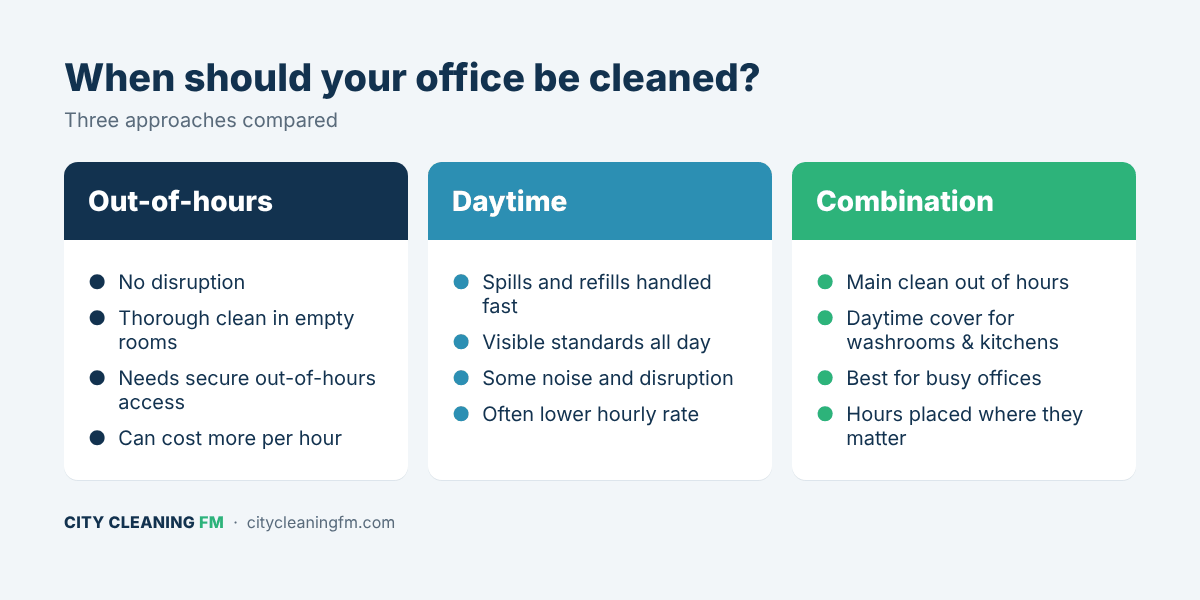
- No disruption. Vacuuming, mopping and washroom cleaning happen in an empty building.
- A fresh start every day. Staff arrive to clean desks, kitchens and washrooms.
- Faster cleaning. Empty rooms are quicker to clean properly, so you get more done in the same hours.
Things to consider
- Security and access. Cleaners need keys, fobs or alarm codes, so vetting and DBS checks matter.
- Cost. Early-morning, late-evening and weekend shifts can carry a higher hourly rate.
- Nobody on hand during the day to deal with spills or replenish washrooms.
Option 2: Daytime cleaning
Cleaners work during office hours, alongside your team. It’s increasingly common, particularly in larger offices and buildings with long opening hours.
Advantages
- Visible standards. Kitchens, washrooms and meeting rooms are kept tidy throughout the day.
- Responsive. Spills, overflowing bins and empty soap dispensers are dealt with straight away.
- Often lower hourly rates and easier staff recruitment than unsocial shifts.
- Simpler security. No out-of-hours access is required.
Things to consider
- Some disruption. Noisy tasks like vacuuming need careful scheduling around meetings and calls.
- Less thorough in busy areas because desks and rooms are in use.
Option 3: A combination
Many offices get the best of both: a main clean out of hours, plus a shorter daytime presence focused on washrooms, kitchens and reception. In larger buildings this daytime role is sometimes a dedicated day cleaner or porter.
A combination works well when:
- Your office has heavy kitchen or washroom use
- You regularly host clients or visitors
- The building is open long hours or used in shifts
How hybrid working changes the picture
With many London teams in the office only some days of the week, a fixed daily schedule can mean paying to clean empty desks. Look at when your office is actually busy. A common pattern is a full clean on busy days and a lighter clean, focused on washrooms, kitchens and bins, on quiet days. The total hours drop without standards slipping where people notice.
How often should an office be cleaned?
As a general guide:
- Washrooms and kitchens: every working day the office is in use
- Bins and recycling: daily, or on each visit
- Desks, floors and meeting rooms: daily in busy offices, two or three times a week in quieter ones
- Deep cleaning, carpets and windows: periodically, monthly to annually depending on use
The right answer depends on headcount, how the space is used and what impression you need to make. A written cleaning specification is the easiest way to set it out.
Quick comparison
| Out-of-hours | Daytime | Combination | |
|---|---|---|---|
| Disruption | None | Some | Minimal |
| Thoroughness | High | Moderate | High |
| Responsiveness during the day | Low | High | High |
| Hourly cost | Can be higher | Often lower | Mixed |
| Out-of-hours access needed | Yes | No | Yes |
Find the right schedule for your office
City Cleaning FM provides daily and out-of-hours cleaning for offices across London. We start with a free on-site survey, look at how your space is actually used, and recommend a schedule that puts the hours where they make a difference. Our teams are vetted, DBS-checked and uniformed, so out-of-hours access is handled securely, and regular quality audits keep standards consistent.
See our office cleaning services in London to request a quote, or read our guide to office cleaning costs.
Frequently asked questions
Is it better to clean an office in the morning or evening?
Both work. Evening cleans suit offices that close at a set time; early-morning cleans mean the office is freshest when staff arrive. The choice usually comes down to access and building hours.
Does out-of-hours cleaning cost more?
It can. Early, late and weekend shifts sometimes carry a higher hourly rate, but empty offices are faster to clean, which offsets some of the difference.
How do cleaners access the office out of hours?
Usually with keys or fobs and an alarm code issued to named, vetted staff, with sign-in and lone-working procedures agreed in advance.
Should I reduce cleaning if staff work from home part of the week?
Often, yes. Match the cleaning hours to occupancy, but keep washrooms and kitchens on a daily schedule whenever the office is in use.
Get a free on-site survey
Commercial cleaning for London businesses only. Vetted, DBS-checked teams, a written specification and regular quality audits. Call 020 7101 4412 or request a quote online.
