
Most problems with office cleaning come down to one thing: nobody wrote down what “clean” means. A cleaning specification fixes that. It’s a simple document listing every area, every task and how often each task is done, and it becomes the standard your contractor is measured against.
This guide explains what to include, gives you a ready-made structure, and shows how a good specification helps you get fair, comparable quotes.
Why a written specification matters
- Fair quotes. Every supplier prices exactly the same job, so you can compare like with like.
- Clear expectations. Cleaners, supervisors and your own staff all know what’s done and when.
- Measurable quality. Audits check work against the specification, not against opinions.
- Easier changes. When your needs change, you update one document.
Step 1: List every area
Walk the building and list each type of space. Most offices include:
- Reception and entrance
- Open-plan desk areas
- Private offices
- Meeting and boardrooms
- Kitchens, tea points and breakout areas
- Washrooms and showers
- Corridors, stairs and lifts
- Storage, comms and plant rooms (often limited access)
Note the floor types in each area (carpet, vinyl, timber, stone) and any area with restricted access or special requirements.
Step 2: Set tasks and frequencies
For each area, list the tasks and how often they’re done: daily, several times a week, weekly, monthly or periodically. Here’s a typical starting point for an office:
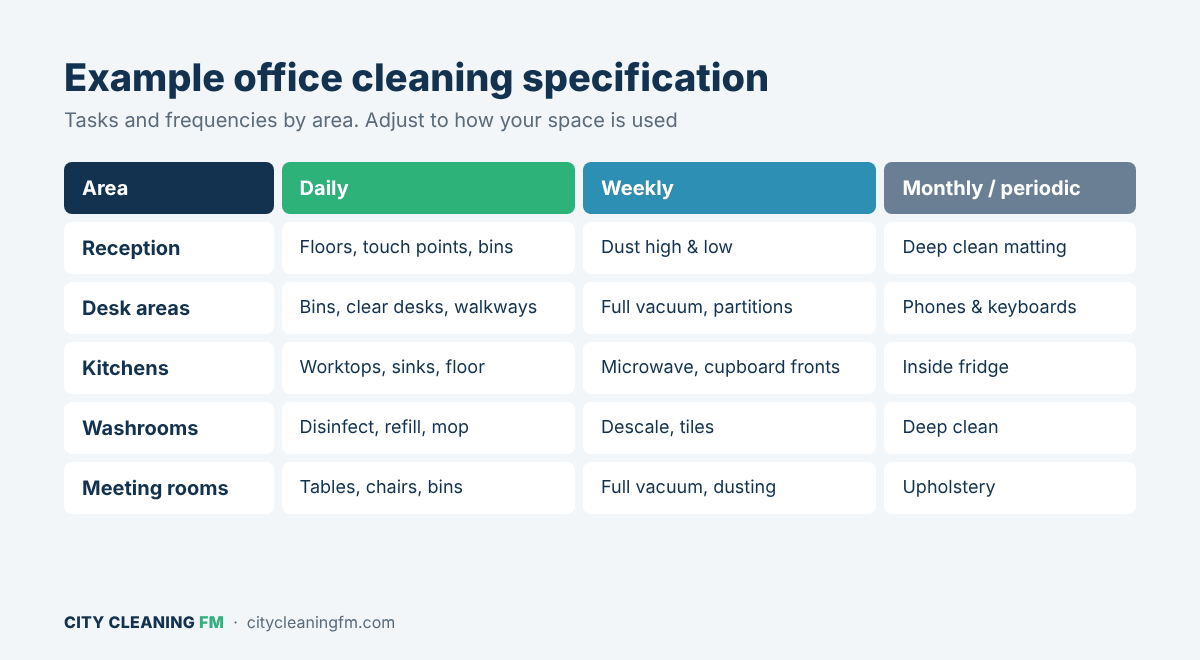
| Area | Daily | Weekly | Monthly / periodic |
|---|---|---|---|
| Reception | Vacuum or mop floors, wipe desk and touch points, empty bins, clean entrance glass | Dust high and low surfaces | Deep clean entrance matting |
| Desk areas | Empty bins and recycling, wipe clear desk surfaces, vacuum walkways | Full vacuum including under desks, dust partitions and sills | Clean phones and keyboards, spot-clean carpets |
| Kitchens | Clean worktops, sinks and taps, wipe appliance fronts, empty bins, mop floor | Clean inside microwave, wipe cupboard fronts | Clean inside fridge (with notice to staff) |
| Washrooms | Clean and disinfect toilets, urinals, basins and taps, refill consumables, mop floor | Descale, clean partitions and tiles | Deep clean, high-level dusting |
| Meeting rooms | Wipe tables, tidy chairs, empty bins | Vacuum fully, dust surfaces | Clean upholstery as needed |
Adjust frequencies to how your space is actually used. A meeting room used twice a week doesn’t need daily cleaning; a kitchen serving 60 people may need attention twice a day.
Step 3: Add periodic work
Some tasks happen a few times a year and are usually priced separately. List them so suppliers can quote:
- Carpet deep cleaning
- Hard floor scrubbing, sealing or polishing
- Internal and external window cleaning
- High-level dusting (lights, vents, ledges)
- Upholstery cleaning
Step 4: Include the practical details
- Cleaning times: early morning, evening, or during the day. See our guide to daily versus out-of-hours cleaning.
- Access and security: keys, fobs, alarm codes, sign-in and lone-working rules
- Consumables: who supplies toilet roll, hand towels, soap and bin liners
- Waste and recycling: where it goes and how it’s separated
- Restricted areas: anywhere cleaners shouldn’t enter or touch, such as server rooms or clear-desk rules
- Reporting: how issues are logged and how often quality is audited
Step 5: Define how quality is measured
A specification is only useful if someone checks against it. Agree how often audits happen, who carries them out, how results are shared and what happens when a standard isn’t met. A simple scoring system per area works well and makes trends easy to spot.
Using your specification to get quotes
Send the same specification to each contractor and ask them to confirm the weekly hours and number of staff needed to deliver it. That’s the quickest way to see whether a low quote is efficient or simply under-resourced. Our guide to office cleaning costs in London explains what to expect.
Don’t want to write it yourself?
You don’t have to. At City Cleaning FM, every contract starts with a free on-site survey. We walk the building with you, agree what matters, and produce the written specification for you, so you know exactly what you’re paying for. Our vetted, DBS-checked teams then work to it, and regular quality audits check that they do.
Request a survey for office cleaning in London.
Frequently asked questions
What is a cleaning specification?
A document listing each area of your premises, the cleaning tasks for each, and how often they’re done. It forms the basis of the contract and quality checks.
How detailed should a cleaning specification be?
Detailed enough that two contractors would price the same job. List areas, tasks and frequencies; you don’t need to describe cleaning methods.
Should the specification be part of the contract?
Yes. Attach it to the contract so standards are enforceable and easy to review.
How often should a cleaning specification be reviewed?
At least once a year, and whenever your use of the building changes, such as new hybrid working patterns or an office move.
Get a free on-site survey
Commercial cleaning for London businesses only. Vetted, DBS-checked teams, a written specification and regular quality audits. Call 020 7101 4412 or request a quote online.
