

Unhappy with your current cleaners but worried that changing will be more hassle than it’s worth? Switching cleaning contractors is straightforward when it’s planned properly. Most of the risk sits in three places: the notice period in your existing contract, the employment rights of the current cleaning team, and the first few weeks of the new service.
This guide takes you through each step so the changeover happens without a gap in cleaning.
Step 1: Check your current contract
Find your existing agreement and look for:
- The notice period. One to three months is typical. Some contracts require notice in writing to a specific address.
- Minimum term or renewal date. Some contracts roll over automatically if notice isn’t given before a set date.
- Termination for poor performance. If standards have failed, there may be a route to end the contract sooner.
- Equipment and consumables. Who owns what’s in your cleaning cupboard?
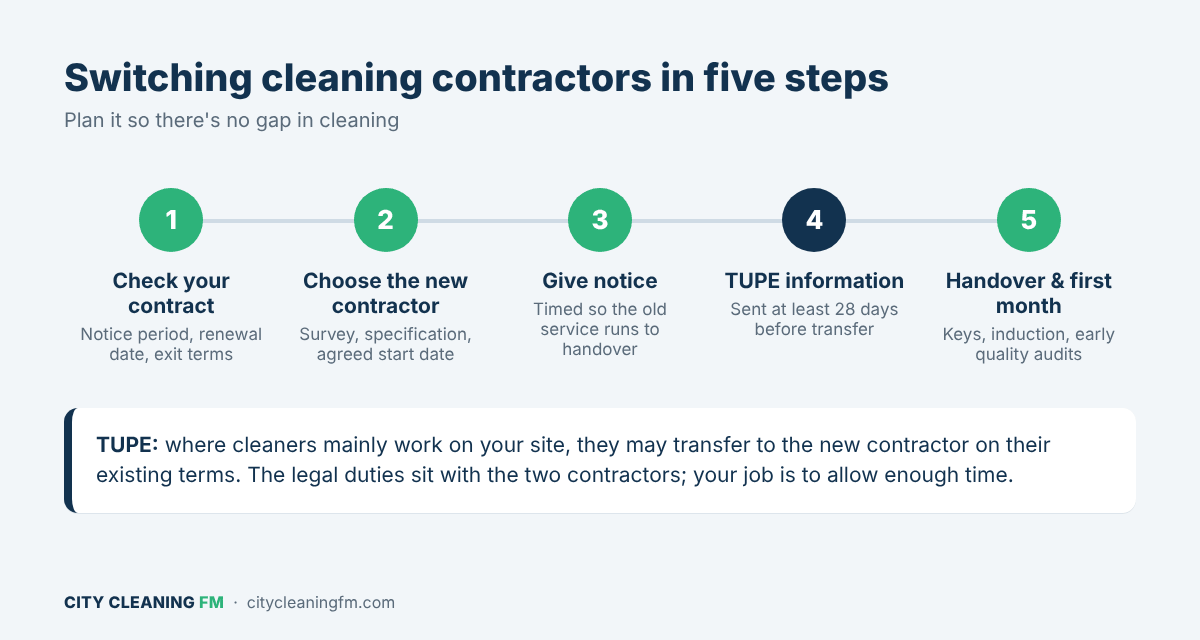
Don’t give notice until you’ve chosen the new contractor and agreed a start date. That way the old service runs right up to the handover.
Step 2: Understand TUPE before you give notice
The Transfer of Undertakings (Protection of Employment) Regulations 2006, known as TUPE, often apply when a cleaning contract moves from one company to another. Acas explains that this is called a “service provision change”, and it can apply where there’s an organised group of employees whose main purpose is to carry out work for your business, even if that group is a single cleaner.
In practice, that means the cleaners who mainly work on your site may have the right to transfer to the new contractor on their existing terms and conditions. The new contractor can’t simply choose not to take them on.
What TUPE means for you as the client
The legal obligations sit mainly with the outgoing and incoming contractors, not with you. The outgoing contractor must send the incoming contractor employee liability information at least 28 days before the transfer, and both employers have duties to inform and consult the affected staff.
Your role is to make sure the timeline allows for this and that both companies are talking to each other. Practically, that means:
- Telling prospective contractors early whether staff are likely to transfer, so their quotes reflect the real cost
- Giving enough notice for the 28-day information requirement and staff consultation
- Asking your new contractor how they’ll manage the transfer and induct any transferring staff
TUPE is a detailed area of employment law. If there’s any doubt about whether it applies, take advice. The guidance from Acas on handling a TUPE transfer is a good starting point.
Is TUPE a reason not to switch?
No. Transferring staff can be a strength: they already know your building. A good incoming contractor will retrain them to their own standards, introduce proper supervision and quality checks, and deal with any performance issues fairly. If the problem was poor management rather than poor people, a change of contractor often fixes it.
Step 3: Agree the specification and start date
Use the change as a chance to reset expectations. Agree a written specification with the new contractor covering every area, task and frequency. If the old service fell short, write down exactly where, so it doesn’t happen again. Our guide to writing a cleaning specification can help.
Then agree a start date that matches the end of your notice period, so there’s no gap in cleaning.
Step 4: Plan the handover
A smooth handover covers:
- Keys, fobs and alarm codes: collected from the old contractor, issued to the new one, with codes changed if needed
- Access times and security procedures: sign-in, lone working, locking up
- Consumables and equipment: what stays, what goes, and who’s restocking from day one
- Site induction: a walk-round with the new team and supervisor before the first clean
- Contacts: who to call on your side and theirs
Step 5: Watch the first month closely
The first few weeks set the standard. Ask for a quality audit at the end of week one and again at the end of the first month, and agree any adjustments to the schedule. A good contractor will want this feedback.
Thinking of switching?
City Cleaning FM takes on contracts from other providers across London regularly. We start with a free on-site survey, provide a written specification, plan the handover with you and, where TUPE applies, work with the outgoing contractor so staff transfer properly. Every contract has one account manager and regular quality audits from the first week.
Request a quote for office cleaning or contract cleaning in London.
Frequently asked questions
How much notice do I need to give my cleaning company?
It depends on your contract. One to three months is typical. Check for any automatic renewal date too.
Does TUPE always apply when changing cleaners?
Not always, but it often does when the same cleaning work moves from one contractor to another and there’s a team mainly assigned to your site. Take advice if you’re unsure.
Can the new contractor refuse to take on the existing cleaners?
If TUPE applies, employees assigned to your contract transfer automatically on their existing terms. The new contractor can’t pick and choose.
Will there be a gap in cleaning when I switch?
There shouldn’t be. Agree the new start date before giving notice, and make sure keys and access are handed over before the first clean.
Get a free on-site survey
Commercial cleaning for London businesses only. Vetted, DBS-checked teams, a written specification and regular quality audits. Call 020 7101 4412 or request a quote online.
