
Choosing a commercial cleaning company is one of those decisions that seems simple until it goes wrong. A poor contractor costs you more than the invoice: missed areas, complaints from staff, a reception that doesn’t impress clients, and the time you spend chasing it all.
This checklist covers what to look for, what to ask and the warning signs to avoid when choosing a commercial cleaner for your London premises.
Start with what you actually need
Before you contact anyone, write down the basics: the areas to be cleaned, how often, when the building is accessible, and anything specialist such as hard floors, carpets or high-level windows. A short written brief means every supplier quotes for the same job, which makes comparison far easier. If you want to go further, our guide to writing a cleaning specification walks you through it.
The checklist: 10 things to check
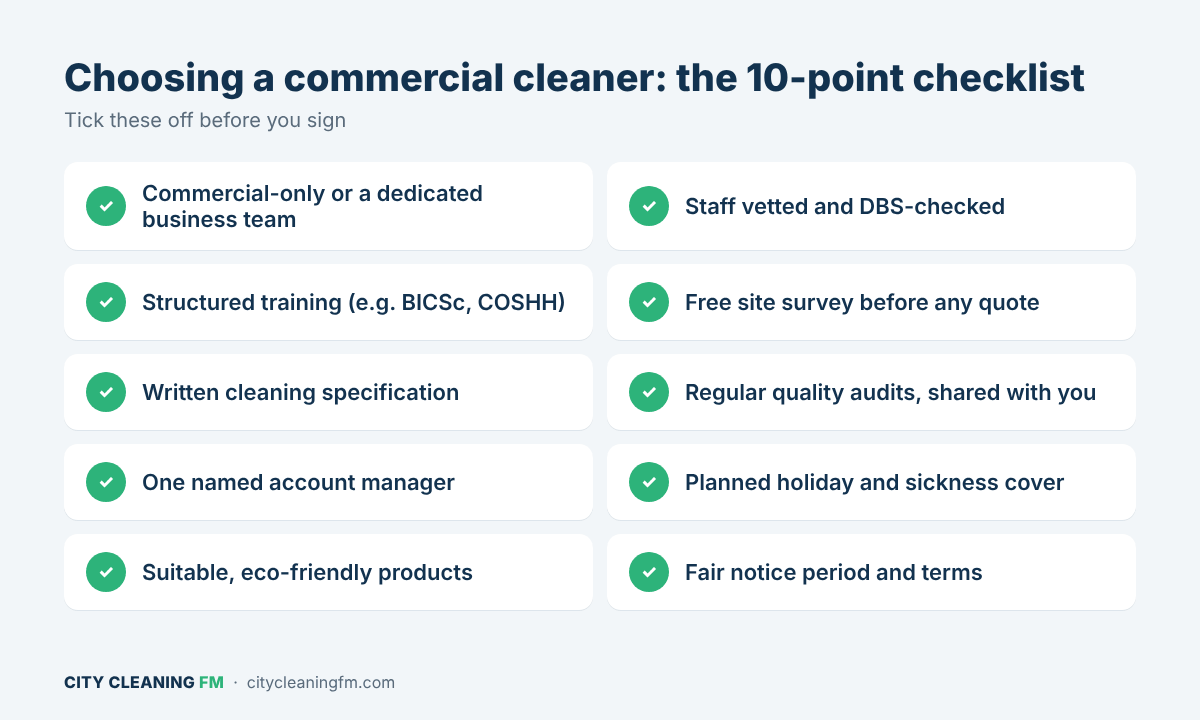
1. They only do commercial work, or have a dedicated commercial team
Cleaning an office, gym or school is different from cleaning a home. It’s about schedules, access control, consistent standards across shifts and reporting. A contractor focused on business clients will have the systems for it.
2. Staff are vetted and DBS-checked
Cleaners often work unsupervised, out of hours, with keys and alarm codes. Ask how staff are recruited, whether they’re DBS-checked and how right-to-work checks are carried out. This matters even more for schools, healthcare settings and offices holding sensitive information.
3. Training is structured, not informal
Ask what training cleaners receive before they start on your site, and whether it follows a recognised standard such as BICSc. Training covers more than technique: it includes safe use of chemicals (COSHH), colour-coding to prevent cross-contamination, and how to work safely alone.
4. They visit before they quote
A reliable price needs a site survey. Any company that quotes a fixed monthly price over the phone without seeing your premises is guessing, and you’ll pay for the guess one way or another.
5. You get a written specification
The quote should come with a clear specification listing tasks, areas and frequencies. If it isn’t written down, it isn’t in the contract.
6. Quality is checked, not assumed
Ask how standards are monitored. Good contractors carry out regular quality audits, share the results and act on them. You shouldn’t be the one discovering problems.
7. One point of contact
When something needs fixing, you want one named person who knows your site, not a general inbox. Ask who your account manager will be and how quickly they respond.
8. Cover for holidays and sickness
Every cleaning team has absences. The question is what happens next. Ask how cover is arranged and whether replacement staff are briefed on your site before they arrive.
9. Products and equipment are suitable
Ask what’s supplied and whether eco-friendly products are used as standard. Check the equipment suits your floors and surfaces.
10. The contract is fair
Look at the notice period, minimum term, how price increases are handled and what happens if standards slip. Long lock-ins with no performance clauses are a red flag.
Questions to ask at the site survey
- How many hours a week is your quote based on, and how many cleaners?
- Who will supervise the team, and how often will they visit?
- How do you record and report quality checks?
- What happens if a cleaner doesn’t turn up?
- How are keys, alarm codes and access managed?
- What’s included, and what would be charged as an extra?
- Are you able to provide references from similar businesses?
Warning signs
- A price without a visit. It will either go up later or the job will be under-resourced.
- A quote far below the others. Fewer hours or lower wages usually explain it, and both show up in the results.
- Vague answers about staff. If they can’t tell you how people are vetted and trained, assume they aren’t.
- No mention of quality checks. Without audits, standards drift.
- High-pressure sales. A good contractor is happy for you to take time and compare.
Don’t forget the handover
If you’re replacing an existing contractor, the change needs planning. The existing cleaning team may have the right to transfer to the new company under TUPE. Read our guide to switching cleaning contractors before you give notice.
How City Cleaning FM works
We provide cleaning for businesses only: offices, schools, gyms, healthcare settings and venues across London. Every contract starts with a free on-site survey and a written specification. Our teams are vetted, DBS-checked, BICSc-trained and uniformed, we use eco-friendly products, and every site gets regular quality audits and one account manager.
Find out more about our commercial cleaning in London or contract cleaning and book your free survey.
Frequently asked questions
How many quotes should I get for commercial cleaning?
Three is usually enough. Give each supplier the same brief so you’re comparing like with like.
What accreditations should a commercial cleaner have?
Look for evidence of proper vetting (DBS checks), structured training such as BICSc, and documented health and safety procedures. Ask to see them rather than relying on logos.
How long should a cleaning contract be?
Twelve months is common, with a notice period of one to three months. Avoid long minimum terms without clear performance standards.
Should I choose the cheapest cleaning company?
Only if the hours, staffing and inclusions are the same as the others. A lower price normally means fewer hours on site.
Get a free on-site survey
Commercial cleaning for London businesses only. Vetted, DBS-checked teams, a written specification and regular quality audits. Call 020 7101 4412 or request a quote online.
